


Best AI tools for building AI agents
- AI Image Generators Software AI Writing Assistant Popular Tools AI Tools
Choosing the right platform is one of the most important decisions you’ll make when building AI agents. Whether you’re creating autonomous workflows, customer support bots, or complex multi-step reasoning systems, the tools you pick will have a huge impact on your flexibility, scalability, and how fast you can actually develop.
In this guide, we explore the best platforms for building AI agents, including LangChain and CrewAI. We also show how platforms like Subscribed.fyi help you discover, compare, and evaluate AI agents tools through real reviews, feature breakdowns, and curated alternatives.
What are AI agent platforms
AI agent platforms are tools and frameworks that allow developers to build systems capable of autonomous decision-making, task execution, and multi-step reasoning.
These platforms typically support:
- Task planning and execution
- Memory and context management
- Tool and API integrations
- Multi-agent collaboration
- Automation workflows
Modern AI agents go beyond simple chatbots. They can research, execute tasks, call APIs, and collaborate with other agents to complete complex objectives.
Overview of top AI agent tools
LangChain
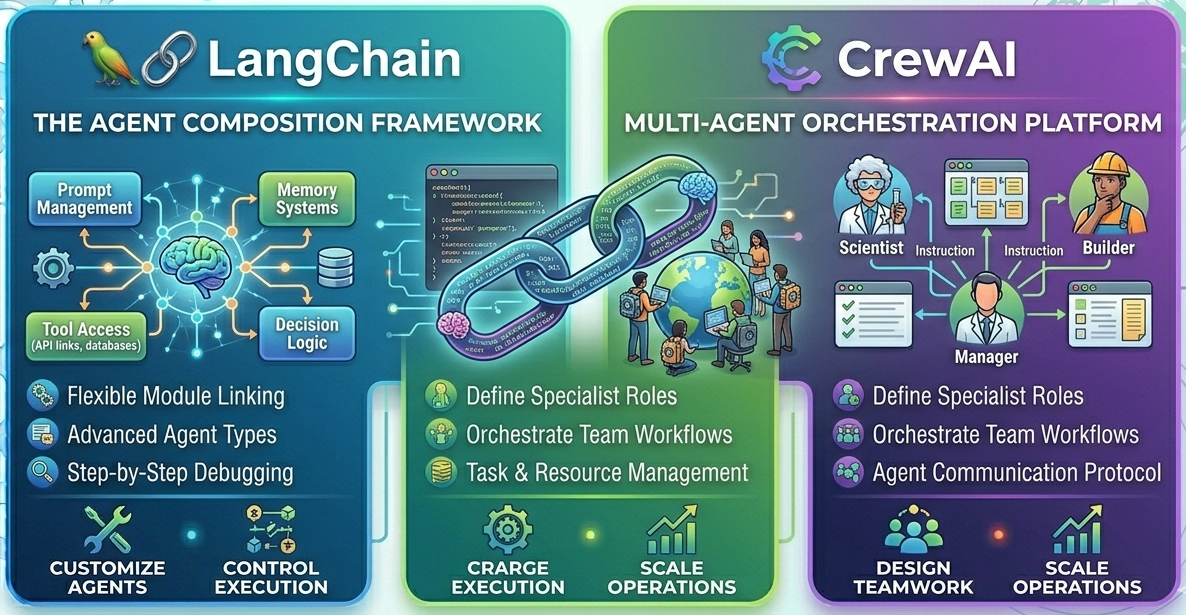
LangChain is one of the most widely used frameworks for building AI agents. It provides modular components that allow developers to chain together prompts, memory, tools, and APIs into structured workflows.
It is especially useful for building custom AI agents with fine-grained control.
Key features
- Modular chains and agents
- Memory and context handling
- Integration with APIs and databases
- Support for multiple LLM providers
Pros
- Highly flexible
- Large ecosystem
- Strong community support
Cons
- Steeper learning curve
- Requires more setup
Best for developers who want full control over AI agents.
CrewAI
CrewAI focuses on multi-agent collaboration, where multiple AI agents work together with assigned roles.
This makes it ideal for more complex workflows that require coordination.
Key features
- Multi-agent orchestration
- Role-based agents
- Task delegation
- Collaborative workflows
Pros
- Great for team-based agent systems
- Structured workflows
- Easier orchestration
Cons
- Newer ecosystem
- Fewer integrations than LangChain
Best for multi-agent systems and collaborative AI workflows.
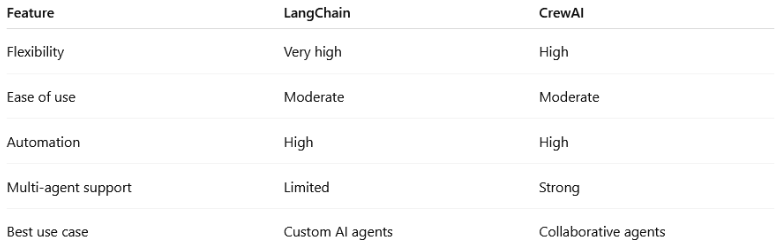
Comparison of AI agent tools
Real world use cases
Different tools shine depending on the use case.
LangChain is commonly used for building production-grade AI agents such as customer support systems, internal knowledge assistants, and API-integrated workflows. For example, startups use it to connect LLMs with databases and automate internal operations.
CrewAI is ideal for structured workflows involving multiple agents. For instance, a content pipeline might include one agent for research, another for writing, and another for editing, all working together.
You can explore more real-world use cases and comparisons through Subscribed.fyi, which aggregates insights across AI agents platforms.
How to choose the right AI agent tool
The best tool depends on your goals.
If you want full customization and control, LangChain is the strongest option. If you need multiple agents working together, CrewAI stands out.
For most teams, the decision comes down to balancing flexibility, automation, and ease of use.
Using a comparison platform like Subscribed.fyi comparisons helps you evaluate these tools side by side without guesswork.
Conclusion
Building AI agents is no longer limited to advanced teams. With tools like LangChain and CrewAI, developers can now create powerful systems with automation and multi-step reasoning.
However, choosing the right platform can be challenging. Subscribed.fyi becomes valuable. It allows you to explore AI agents tools, compare features, read real user feedback, and discover better alternatives tailored to your needs.
If you want to build smarter AI agents without wasting time or resources, start by exploring the best tools on Subscribed.fyi AI agents page.