


Best open source LLM tools for startups
- AI Image Generators Software AI Writing Assistant Popular Tools AI Tools WebOps Platforms Bug Tracking & Feedback Software Web Development & Design
Choosing the right open source LLM stack is one of the biggest decisions startups face when building AI products today. The tools you go with directly shape your cost structure, how flexible your product can be, and how easily you can scale without getting stuck with vendor lock-in.
Open source LLMs (large language models) have come a long way very quickly. They now give startups access to seriously powerful AI capabilities without having to rely completely on expensive paid APIs. With strong developer communities behind them, these tools make it much easier and more affordable to ship production-ready AI features fast.
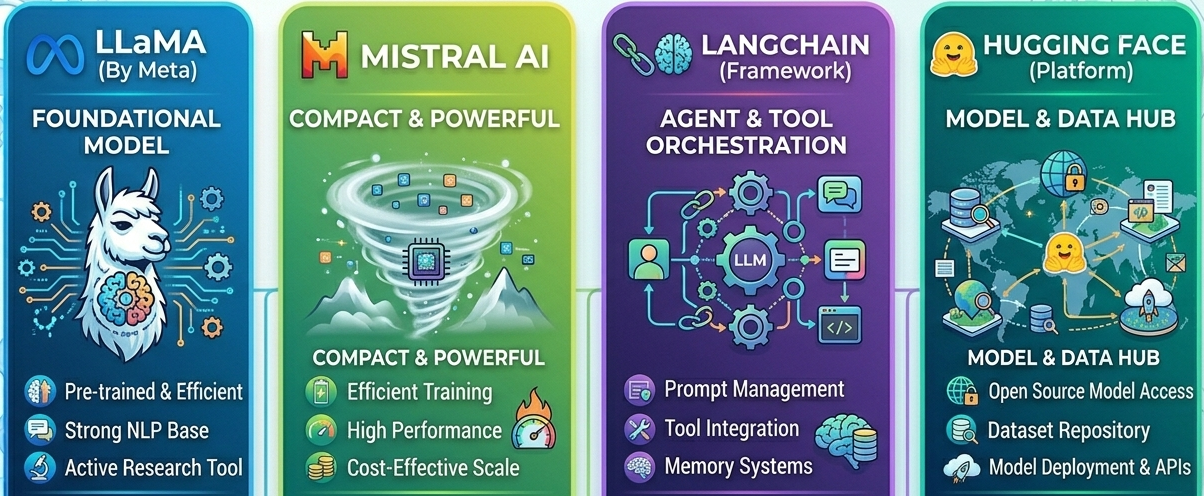
If you want to explore and compare tools in this space, platforms like Subscribed.fyi help you discover open source, LLM, startups tools, evaluate alternatives, and find the right stack for your use case like LLaMA and Mistral, frameworks like LangChain, and platforms like Hugging Face.
What are open source LLM tools
Open source LLM tools include models, frameworks, and infrastructure that allow developers to run, fine-tune, and deploy language models without proprietary restrictions.
These tools typically support:
- Self-hosting or local deployment
- Model fine-tuning and customization
- Integration with apps via APIs or SDKs
- Strong community-driven improvements
For startups, this means lower costs, more control, and faster iteration compared to closed systems.
LLaMA and derivatives
Developed by Meta, LLaMA models have become a foundation for many open source LLM ecosystems.
Key strengths include strong performance-to-size ratio and a large number of community fine-tuned variants like LLaMA 2 and LLaMA 3-based models.
Startups often use LLaMA for:
- Building custom chatbots
- Internal knowledge assistants
- Domain-specific fine-tuned models
Compared to proprietary APIs, LLaMA gives more control over data and deployment, especially for privacy-sensitive applications.
Mistral models
Mistral AI has quickly gained attention for releasing high-performance open-weight models like Mistral 7B and Mixtral.
These models are optimized for efficiency while maintaining strong reasoning and generation capabilities.
Why startups choose Mistral:
- Lower compute requirements
- Competitive performance vs larger models
- Strong support for fine-tuning
Mistral AI is especially useful for startups that want near state-of-the-art performance without heavy infrastructure costs.
Hugging Face ecosystem
Hugging Face is not just a model provider but a full ecosystem for open source AI.
It offers:
- Model hub with thousands of LLMs
- Transformers library for development
- Inference endpoints and deployment tools
Real-world use cases include:
- Rapid prototyping of AI features
- Accessing multiple models in one place
- Benchmarking and experimentation
For startups, Hugging Face acts as the central hub for discovering and testing LLMs before committing to a stack.
LangChain
LangChain is a framework designed to help developers build applications powered by LLMs.
It simplifies:
- Prompt chaining
- Tool integration
- Memory handling
- Agent workflows
Startups use LangChain to:
- Build AI agents
- Connect LLMs to databases and APIs
- Create multi-step reasoning systems
Compared to raw model usage, LangChain accelerates development by abstracting complex orchestration logic.
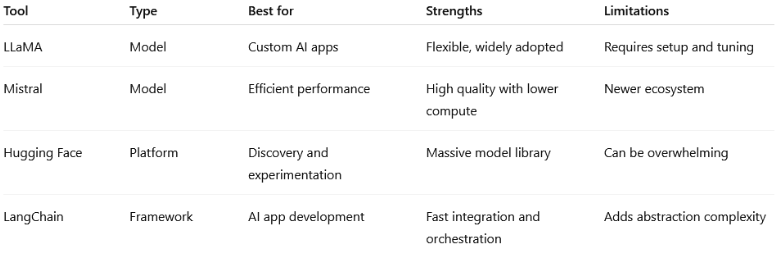
Comparison of open source LLM tools
Real use cases for startups
Startups are already using these tools in production across different industries.
SaaS companies use LLaMA or Mistral to power customer support chatbots that reduce support costs.
Ecommerce startups integrate LangChain with product databases to create AI shopping assistants.
EdTech platforms use Hugging Face models to generate personalized learning content.
These examples highlight how open source LLM tools are not just experimental, they are practical and scalable.
How to choose the right tool
The right choice depends on your startup’s priorities.
If you need full control and customization, LLaMA-based models are a strong foundation.
If efficiency and performance balance matter most, Mistral is a smart choice.
If you want flexibility and fast experimentation, Hugging Face is essential.
If you are building complex AI workflows, LangChain simplifies development.
Conclusion
Open source LLM tools are redefining how startups build AI products. Instead of relying entirely on expensive APIs, teams can now create cost-effective, scalable, and customizable solutions using models like LLaMA and Mistral, frameworks like LangChain, and platforms like Hugging Face.
To explore more tools tailored for open source, LLM, startups, platforms like Subscribed.fyi make it easier to compare options, discover alternatives, and evaluate real-world use cases before committing to your stack.