
Building the Stack: Leading AI Infrastructure and Ops Platforms
-
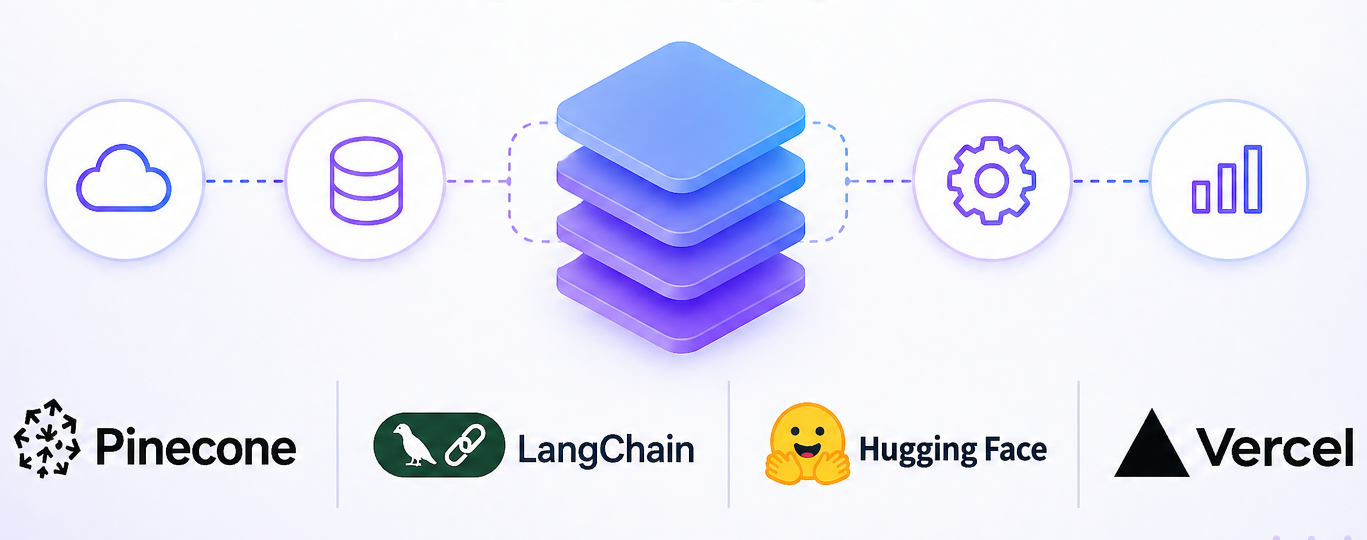
Modern SaaS products are rapidly evolving with large language models at their core. To build reliable and scalable AI applications, teams need a strong infrastructure stack that supports data storage, orchestration, model access, and deployment. Platforms like Pinecone, LangChain, Hugging Face, and Vercel form the backbone of many production-ready systems today.
If you are evaluating tools, you can explore them directly on Subscribed.fyi:
This article breaks down how these platforms fit together and how to choose the right combination for performance, scalability, and cost efficiency.
Understanding the AI infrastructure stack
AI infrastructure for LLM-powered applications typically consists of four layers. Each layer plays a distinct role in ensuring smooth operation from development to deployment.
First is data storage and retrieval. Vector databases like Pinecone allow semantic search across embeddings, which is essential for retrieval augmented generation systems.
Second is orchestration. LangChain helps developers connect prompts, memory, tools, and APIs into structured workflows.
Third is model access and hosting. Hugging Face provides pre-trained models and inference endpoints that reduce the need to build models from scratch.
Fourth is deployment. Vercel simplifies building and shipping AI applications with optimized frontend and backend integration.
Together, these layers create a full stack that supports both rapid prototyping and production scaling.
Key platforms explained
Pinecone for vector search
Pinecone is a managed vector database designed for high-performance similarity search. It removes the complexity of managing infrastructure and allows developers to focus on building features.
Use case example
A SaaS support chatbot uses Pinecone to store embeddings of knowledge base articles. When a user asks a question, the system retrieves relevant documents and feeds them into an LLM for accurate responses.
LangChain for orchestration
LangChain acts as the glue between different components. It helps manage prompts, chains, agents, and memory.
Use case example
An AI-powered research assistant uses LangChain to combine search APIs, summarization prompts, and memory tracking into a cohesive workflow.
Hugging Face for model access
Hugging Face provides access to thousands of open-source models and datasets. It also offers hosted inference endpoints.
Use case example
A startup building a text classification feature uses Hugging Face models to avoid training from scratch, reducing both time and cost.
Vercel for deployment
Vercel simplifies deploying AI-powered applications with fast, scalable infrastructure and seamless frontend integration.
Use case example
A SaaS platform deploys a chat interface using Vercel, enabling fast streaming responses and a smooth user experience.
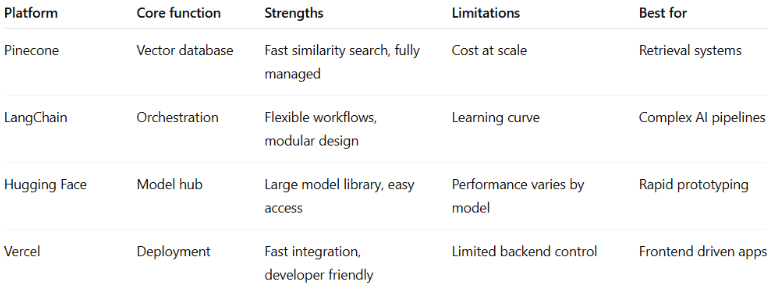
Comparison of leading AI infrastructure tools
Real world stack example
A typical SaaS AI application might use the following setup:
- Pinecone for storing embeddings of user data
- LangChain for orchestrating prompts and workflows
- Hugging Face for accessing pretrained models
- Vercel for deploying the application interface
This combination allows teams to move from idea to production quickly while maintaining efficiency and scalability.
Choosing the right stack
Selecting the right tools depends on your priorities.
If your focus is performance, prioritize Pinecone and efficient model hosting.
If flexibility matters most, LangChain provides deep customization.
If speed to market is critical, Hugging Face and Vercel help reduce development time.
Cost is also a major factor. Managed services reduce operational burden but can become expensive at scale. Balancing managed and self-hosted solutions is often the best approach.
Conclusion
Building a reliable AI stack requires combining specialized tools that handle different parts of the pipeline. Platforms like Pinecone, LangChain, Hugging Face, and Vercel provide the foundation for scalable and efficient AI applications.
To explore these tools further, visit their Subscribed.fyi pages:
By combining the right infrastructure components, SaaS teams can deliver high-performance AI experiences while keeping costs under control and scaling with confidence.
Relevant links