
Choosing the Right Vector Database for Your Generative AI App
- AI Image Generators Software AI Writing Assistant Popular Tools AI Tools
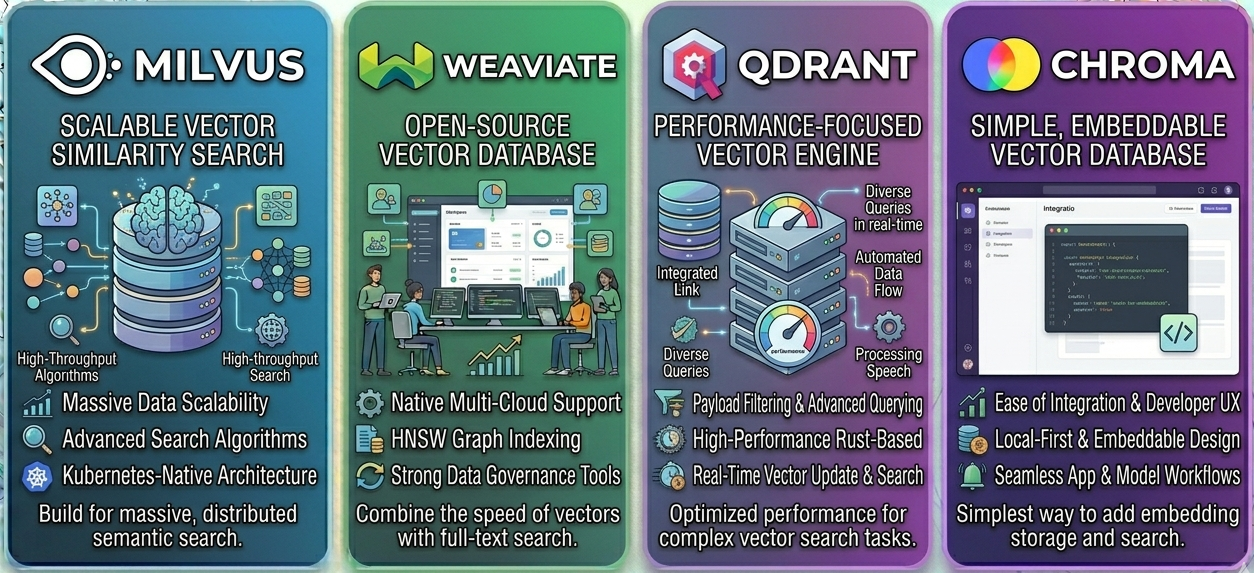
Efficient data retrieval is the backbone of Retrieval Augmented Generation. Without a reliable way to store and search embeddings, even the most advanced models struggle to deliver accurate responses. This is where vector databases come in. Tools like Milvus, Weaviate, Qdrant, and Chroma are widely used to power semantic search and retrieval pipelines in modern AI systems.
If you are building a generative AI app, choosing the right vector database is not just a technical decision. It directly affects performance, scalability, cost, and long-term sustainability. This guide breaks down how these tools compare and how to select the best one for your needs. You can explore each option further through Subscribed.fyi.
Understanding vector databases in generative AI
Vector databases store data as embeddings instead of traditional rows and columns. These embeddings represent the meaning of text, images, or other data types in numerical form. When a user sends a query, the system converts it into a vector and retrieves the most similar stored vectors.
This process enables semantic search, which is critical for Retrieval Augmented Generation. Instead of relying only on a model’s training data, the system fetches relevant external knowledge in real time.
For example, a customer support chatbot can retrieve company documentation stored in a vector database before generating a response. This ensures answers are accurate and up to date.
Key factors when choosing a vector database
Performance is often the first consideration. Fast query response times are essential for real-time applications such as chatbots or recommendation engines. Tools like Milvus and Qdrant are known for high-performance similarity search.
Scalability is equally important. As your dataset grows, your database should handle millions or even billions of vectors without slowing down. Weaviate and Milvus are strong in distributed scaling.
Ease of integration can save significant development time. Chroma is popular among developers for its simplicity and quick setup, especially in smaller projects or prototypes.
Cost is another critical factor. Open source tools provide more control over infrastructure costs, but they require management and optimization effort.
Comparison of top vector databases
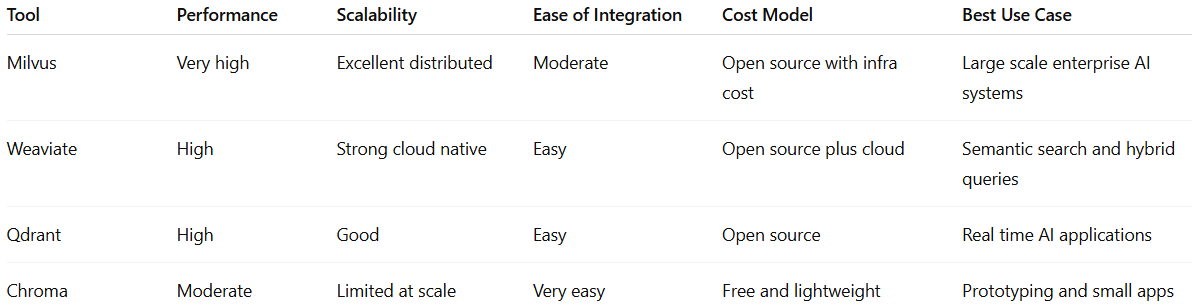
Tool breakdown and real use cases
Milvus is designed for high-performance workloads. It supports distributed architecture, making it suitable for applications that require handling billions of vectors. A common use case is recommendation systems in e-commerce platforms where speed and scale are critical.
Weaviate stands out for its hybrid search capabilities. It combines vector search with keyword filtering, which is useful in applications like content discovery platforms. For example, a news aggregator can use Weaviate to filter by date while still ranking results semantically.
Qdrant focuses on performance and simplicity. It is often used in real-time applications such as chatbots and personalization engines. Its filtering and payload features allow developers to attach metadata to vectors, improving search precision.
Chroma is ideal for developers who want to get started quickly. It integrates easily with popular AI frameworks and requires minimal setup. This makes it a strong choice for prototypes or early-stage startups building proof-of-concept applications.
Cost considerations for long term sustainability
Choosing a vector database is not just about features. Cost can increase rapidly as your application scales.
Open source tools like Milvus, Weaviate, Qdrant, and Chroma allow you to control infrastructure spending. However, they require engineering resources to maintain and optimize.
A practical approach is to start with a lightweight solution like Chroma for prototyping, then move to a scalable option like Milvus or Qdrant as your user base grows.
Conclusion
Selecting the right vector database is a foundational decision for any generative AI application. It impacts how efficiently your system retrieves data, how well it scales, and how sustainable your costs remain over time.
Milvus, Weaviate, Qdrant, and Chroma each offer unique strengths depending on your use case. Whether you prioritize performance, ease of use, or cost control, there is a solution that fits your needs.
To make an informed decision, review detailed insights and comparisons on Subscribed.fyi. By aligning your choice with your application requirements and growth plans, you can build a robust and efficient Retrieval Augmented Generation system that scales with confidence.
Relevant links