

Agentic Workflows for Enterprise AI Infrastructure
- AI Image Generators Software AI Writing Assistant Popular Tools AI Tools
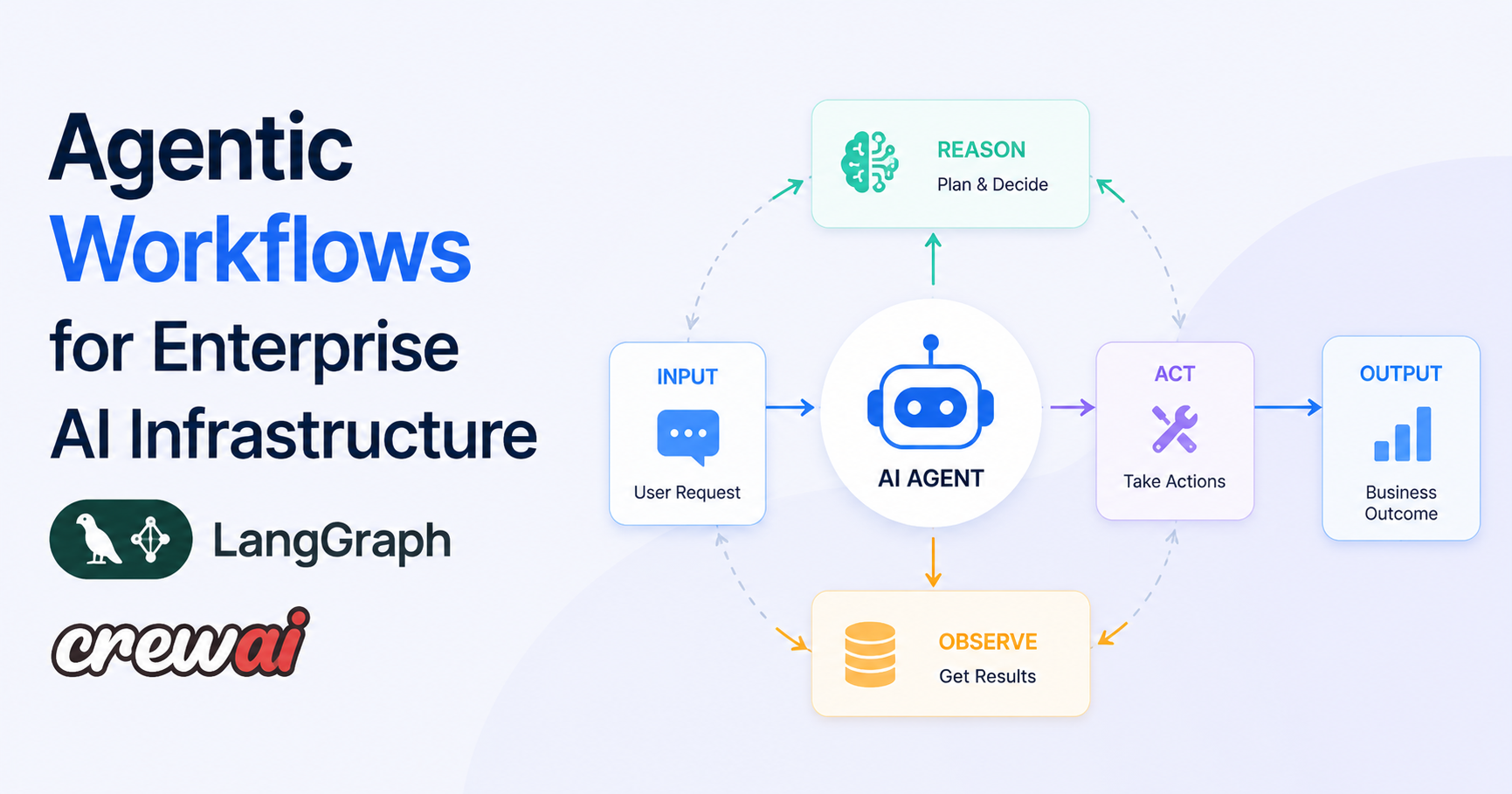
Agentic Workflows: The New Backbone of Enterprise AI Infrastructure
Enterprise AI is undergoing a fundamental shift. The era of single-prompt large language model applications is giving way to agentic workflows, where multiple intelligent agents collaborate, plan, and execute tasks autonomously. This evolution is redefining how organizations build scalable, resilient, and cost-efficient AI systems.
Platforms like LangGraph, CrewAI, and other tools supporting Multi-Agent Systems and Agentic Orchestration are leading this transformation. These tools enable developers to design structured workflows where AI agents can reason, call tools, and interact with each other to achieve complex goals.
What are agentic workflows?
Agentic workflows are systems where multiple AI agents operate together to solve problems. Instead of relying on a single prompt response, these workflows break tasks into steps handled by specialized agents.
Each agent can:
- Plan actions
- Use external tools or APIs
- Store and retrieve memory
- Collaborate with other agents
This structure mirrors human teams, where different roles contribute to a shared objective. It results in better accuracy, scalability, and flexibility compared to monolithic AI pipelines.
Why are enterprises moving beyond single prompt models?
Single prompt systems struggle with complex, multi-step tasks. They lack memory persistence, structured reasoning, and adaptability.
Agentic workflows solve these limitations by introducing:
- Task decomposition for complex problems
- Persistent memory across steps
- Tool integration for real-world actions
- Collaborative reasoning across agents
For example, a customer support automation system can include:
- A triage agent to classify requests
- A knowledge agent to retrieve answers
- An action agent to execute workflows like refunds
This layered approach significantly improves reliability and user experience.
Core frameworks powering agentic orchestration
Several frameworks are emerging as the backbone of agentic infrastructure. Each offers a unique approach to building and managing multi-agent systems.
LangGraph
LangGraph is designed for building stateful, graph-based workflows. It allows developers to define nodes and edges that represent agents and their interactions.
Key strengths:
- Visual and structured workflow design
- Strong support for memory and state management
- Ideal for complex, branching logic
Best for:
- Enterprise workflows with multiple decision paths
- Long-running processes requiring state persistence
CrewAI
CrewAI focuses on role-based agent collaboration. Developers define agents with specific roles and goals, then orchestrate them as a team.
Key strengths:
- Simple abstraction for multi-agent collaboration
- Role-based task delegation
- Fast setup for production use
Best for:
- Team like AI systems
- Task-oriented workflows, such as content creation or research
These systems are essential for enterprise-grade deployments where reliability and performance are critical.
Framework comparison

Compute and memory considerations
Scaling agentic workflows requires careful planning of compute and memory resources. Unlike single-prompt systems, multi-agent architectures introduce additional overhead.
Compute requirements
Each agent may invoke multiple model calls. This increases:
- Token usage
- API latency
- Overall compute cost
To optimize:
- Use smaller models for simple tasks
- Cache intermediate results
- Limit unnecessary agent interactions
Memory architecture
Agentic systems rely heavily on memory for context and continuity.
Types of memory:
- Short-term memory for active tasks
- Long-term memory for historical data
- External storage, such as vector databases
Efficient memory design reduces redundancy and improves performance.
Cost optimization strategies
To scale cost-effectively:
- Implement selective agent activation
- Use batching for similar tasks
- Monitor usage with observability tools
- Apply fallback mechanisms for lower cost models
Enterprises that optimize these layers can significantly reduce operational expenses while maintaining performance.
Real-world use cases of agentic workflows
Marketing content generation
CrewAI enables teams of agents to research, write, and optimize content collaboratively. This increases output quality and consistency.
IT operations and incident response
LangGraph-based workflows can detect issues, diagnose causes, and trigger automated fixes in real time.
The future of enterprise AI infrastructure
Agentic workflows are not just a trend. They represent a foundational shift in how AI systems are built and deployed.
With tools like LangGraph and CrewAI, organizations can move beyond isolated AI features and build fully autonomous systems powered by Multi-Agent Systems and Agentic Orchestration.
As infrastructure matures, we can expect:
- More standardized orchestration layers
- Improved cost efficiency
- Deeper integration with enterprise systems
Conclusion
Agentic workflows are becoming the backbone of modern enterprise AI infrastructure. They enable scalable, collaborative, and intelligent systems that outperform traditional single-prompt approaches.
By leveraging platforms like LangGraph and CrewAI, businesses can design powerful Multi-Agent Systems and implement robust Agentic Orchestration strategies.
Organizations that adopt this architecture early will gain a competitive advantage through automation, efficiency, and smarter decision-making.
Site-related links