


Best tools for building AI apps in 2026
- AI Image Generators Software AI Writing Assistant Popular Tools AI Tools
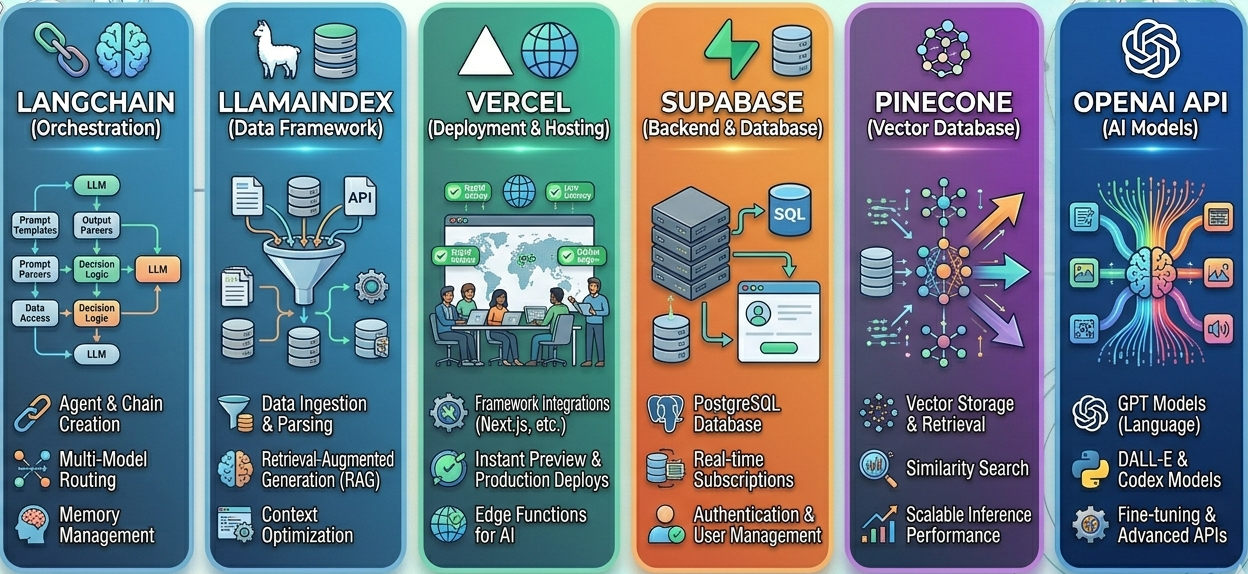
Building modern AI applications requires more than just a powerful model. Developers now rely on a full stack of tools such as LangChain, LlamaIndex, Vercel, Supabase, Pinecone, and OpenAI API to create scalable and production-ready systems. These tools cover everything from AI orchestration and data retrieval to backend infrastructure and frontend deployment.
In this guide, we explore the best tools for building AI apps in 2026 and how they work together across the stack. To simplify your evaluation process, you can explore all these tools through Subscribed.fyi using curated AI build and AI apps.
What are AI app development tools
AI app development tools are platforms and frameworks that help developers design, build, and deploy applications powered by machine learning or large language models. These tools typically fall into three main layers:
- Frontend tools for building user interfaces
- Backend tools for handling logic, APIs, and databases
- AI orchestration tools for managing prompts, workflows, and model interactions
A strong stack combines all three layers into a cohesive system.
LangChain
LangChain is one of the most widely used frameworks for building AI-powered workflows. It helps developers connect language models with external data sources, APIs, and memory systems.
Key features:
- Prompt chaining and workflow automation
- Integration with vector databases
- Support for multiple AI models
- Memory and context management
LangChain is ideal for applications like chatbots, document search systems, and AI copilots. For example, a SaaS company can use LangChain to build a customer support assistant that retrieves answers from internal documentation.
LlamaIndex
LlamaIndex focuses on data ingestion and retrieval for AI applications. It is designed to make structured and unstructured data usable by language models.
Key features:
- Data connectors for files, APIs, and databases
- Indexing and retrieval optimization
- Easy integration with LLMs
- Query engines for fast responses
It is commonly used in enterprise AI apps where accessing internal data is critical. For example, teams use LlamaIndex to build knowledge assistants that answer questions from company documents.
Vercel
Vercel is a leading platform for deploying modern frontend applications, especially those built with frameworks like Next.js.
Key features:
- Fast global CDN delivery
- Serverless functions
- Git based deployment workflows
- Optimized frontend performance
For AI apps, Vercel is often used to deploy user interfaces for chatbots, dashboards, or AI tools. It works well when paired with backend AI services.
Supabase
Supabase is an open-source backend platform that provides databases, authentication, and storage.
Key features:
- PostgreSQL database
- Real-time subscriptions
- Authentication and user management
- API generation
Supabase is useful for AI apps that need to store user data, chat history, or embeddings. For example, an AI writing app can store user prompts and outputs in Supabase for later retrieval.
Pinecone
Pinecone is a vector database designed for similarity search, which is essential for AI applications that rely on embeddings.
Key features:
- High-performance vector search
- Scalable infrastructure
- Real-time updates
- Easy API integration
It is commonly used for semantic search, recommendation systems, and retrieval augmented generation. For example, an AI research assistant can use Pinecone to find relevant documents based on meaning instead of keywords.
OpenAI API
The OpenAI API provides access to powerful language models that can generate text, code, and more.
Key features:
- Advanced language understanding
- Text generation and summarization
- Embeddings for search and retrieval
- Function calling capabilities
It is widely used in production AI apps such as chatbots, writing assistants, and automation tools.
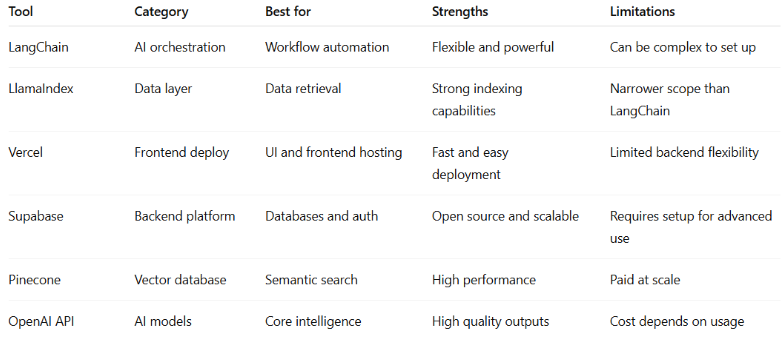
Comparison of top AI app tools

Real use cases
AI customer support assistant
A company combines LangChain, OpenAI API, and Pinecone to build a chatbot that answers customer questions using internal documents.
AI writing application
Developers use OpenAI API for content generation, Supabase for storing drafts, and Vercel for frontend deployment.
AI research tool
Teams integrate LlamaIndex and Pinecone to search through large datasets and deliver relevant insights quickly.
These examples show how combining tools across the stack creates powerful applications.
How to choose the right tools
The best stack depends on your use case:
For rapid prototyping, use OpenAI API with Vercel
For data-heavy apps, combine LlamaIndex with Pinecone
For full-stack apps, use Supabase with LangChain
Conclusion
The best tools for building AI apps in 2026 include LangChain, LlamaIndex, Vercel, Supabase, Pinecone, and OpenAI API, each playing a critical role across the modern AI stack. From orchestrating workflows and retrieving data to managing infrastructure and deploying user interfaces, these tools enable developers to build powerful and scalable applications.
Using the right combination of tools will help you ship faster, reduce costs, and build AI applications that are ready for real-world use. To explore these tools in depth, compare features, and discover alternatives, visit Subscribed.fyi.
Relevant links
- LangChain Reviews
- LlamaIndex Reviews
- Vercel Reviews
- Supabase Reviews
- Pinecone Reviews
- OpenAI API Reviews
- Subscribed Apps