


Essential AI Infrastructure for Enterprise Scaling
- AI Image Generators Software AI Writing Assistant Popular Tools AI Tools
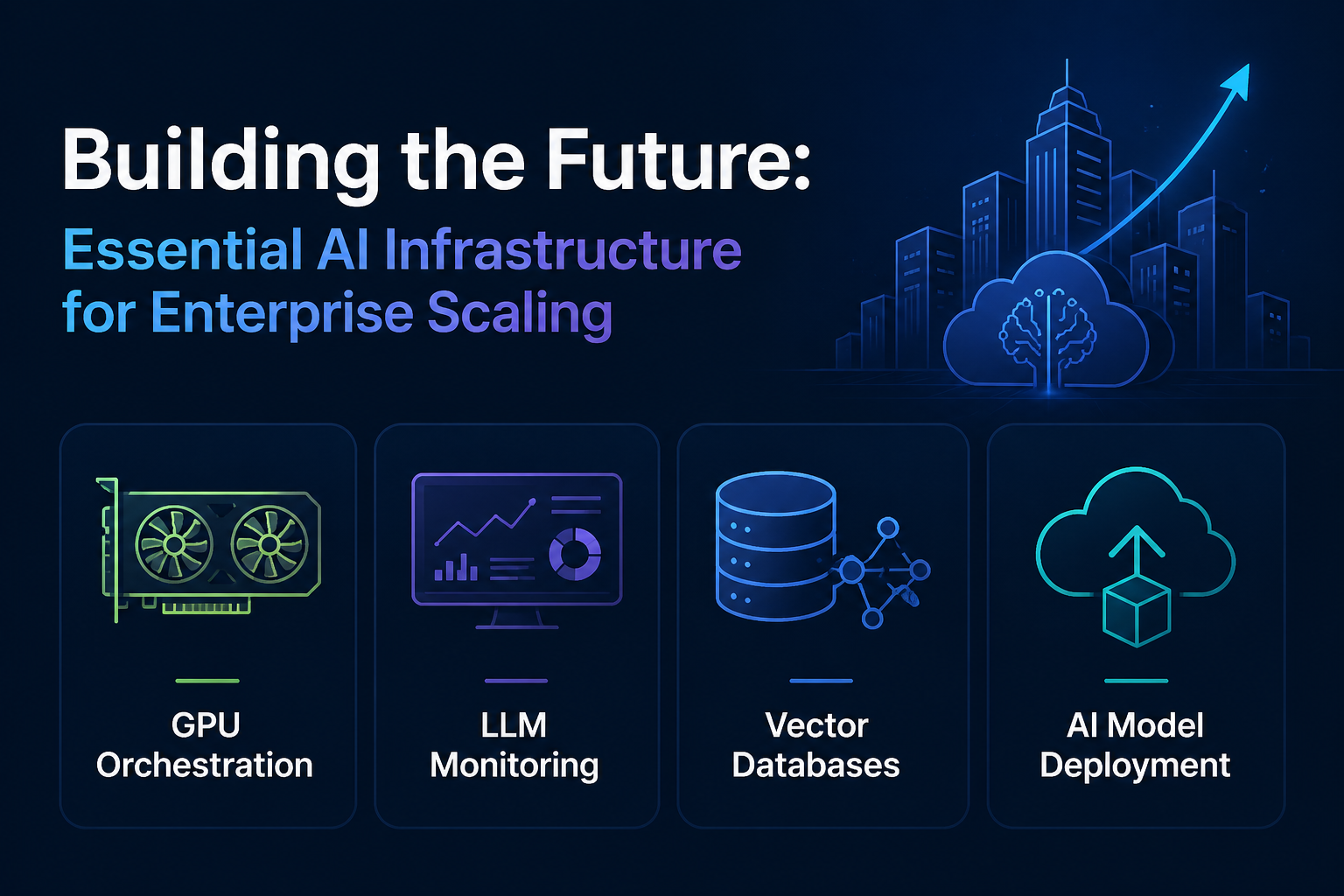
As enterprises accelerate adoption of AI systems, especially large language models, infrastructure decisions become a defining factor in long term success. Teams are no longer just experimenting with models. They are deploying production-grade applications that require reliability, scalability, and cost control. This shift makes components like GPU Orchestration, LLM monitoring, Vector Databases, and AI model deployment essential rather than optional.
Platforms listed on Subscribed.fyi provide a useful starting point for evaluating the modern AI stack. From compute management to data pipelines, these tools help organizations maintain performance while avoiding unnecessary spending. Choosing the right combination ensures that AI applications remain responsive under load and adaptable as requirements evolve.
Understanding the core layers of AI infrastructure
Enterprise AI infrastructure is built across several interconnected layers. Each layer solves a specific problem, but they must work together seamlessly.
GPU Orchestration focuses on efficiently allocating compute resources. Training and inference workloads are expensive, so platforms that optimize GPU usage help reduce waste and improve throughput. Solutions featured on Subscribed.fyi enable dynamic scaling and scheduling based on demand.
LLM Monitoring ensures that deployed models behave as expected. It tracks latency, output quality, and drift over time. Without monitoring, teams risk degraded performance or inaccurate outputs in production. Tools listed on Subscribed.fyi provide visibility into how models perform in real environments.
Vector Databases are critical for retrieval augmented generation and semantic search. They store embeddings and enable fast similarity queries. Platforms available at Subscribed.fyi support scalable indexing and low-latency retrieval.
AI model deployment platforms handle the transition from development to production. They manage versioning, scaling, and integration with applications. Options on Subscribed.fyi simplify rolling out models while maintaining uptime.
Comparing leading AI infrastructure platforms
Below is a comparison of key platform categories and their strengths across enterprise use cases.
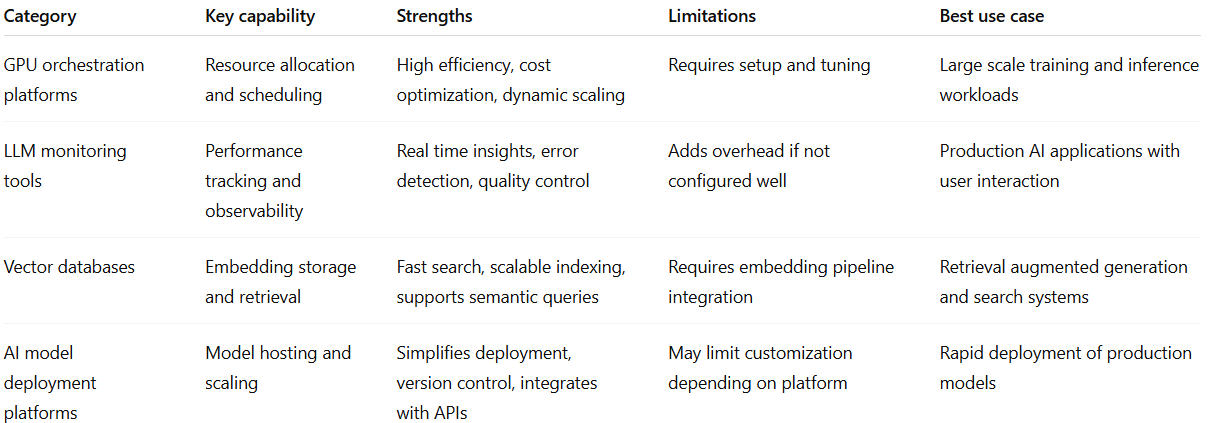
This comparison highlights that no single tool solves everything. Instead, enterprises should combine platforms across these categories to build a resilient system.
Real world use cases of AI infrastructure in action
A customer support platform integrating a chatbot uses Vector Databases to retrieve relevant knowledge base content. GPU Orchestration ensures that inference workloads scale during peak hours. LLM Monitoring tracks response quality and identifies when outputs degrade. AI model deployment platforms manage updates without downtime.
In another scenario, a fintech company uses AI for fraud detection. Real-time processing requires efficient compute allocation. Monitoring tools flag anomalies in model predictions. Deployment platforms enable quick iteration as fraud patterns evolve. This setup ensures both speed and accuracy.
Healthcare organizations also benefit from structured AI infrastructure. Models assist in diagnostics, but performance consistency is critical. Monitoring ensures reliability, while deployment platforms allow controlled updates that meet compliance standards.
How to choose the right stack for enterprise scaling
Selecting infrastructure depends on workload complexity, budget constraints, and team expertise. Companies with heavy compute demands should prioritize GPU Orchestration tools that minimize idle resources. Those with user-facing applications need strong LLM Monitoring to maintain trust and accuracy.
Vector Databases become essential when applications rely on contextual understanding or search. Meanwhile, AI model deployment platforms are critical for teams that frequently update models or manage multiple versions.
Subscribed.fyi provides a curated overview of these tools, making it easier to compare features and pricing. Instead of evaluating platforms in isolation, teams can align their choices with specific infrastructure needs.
Building a future-ready AI infrastructure
Enterprise AI is no longer experimental. It is a core part of digital transformation strategies. As adoption grows, infrastructure decisions will directly impact scalability and cost efficiency.
By leveraging GPU orchestration, LLM Monitoring, Vector Databases, and AI model deployment solutions from Subscribed.fyi, organizations can build systems that are both powerful and sustainable.
The future of AI depends not just on better models, but on better infrastructure. Companies that invest in the right backend systems today will be better positioned to scale, adapt, and compete in an increasingly AI-driven landscape.
Conclusion
Building enterprise AI systems is no longer just about selecting the best model. It is about designing infrastructure that can scale reliably while keeping costs under control. As workloads grow, gaps in GPU orchestration, LLM Monitoring, Vector Databases, and AI model deployment quickly become bottlenecks that impact performance and user experience.
Platforms curated on Subscribed.fyi help simplify this complexity by giving teams a structured way to evaluate and adopt the right tools. Whether you are optimizing compute usage through Orchestration, improving visibility, enabling smarter retrieval, or streamlining releases via Subscribed.fyi, each layer plays a critical role in a modern AI stack.
The key is integration. Enterprises that align these components into a cohesive system can deploy faster, respond to changes more effectively, and maintain consistent performance at scale. Those that overlook infrastructure often face rising costs and unstable applications.
As AI continues to evolve, infrastructure will define the difference between experimentation and real impact. Investing in the right foundation today ensures that your AI initiatives remain scalable, efficient, and ready for the future.