Sign in to review
Join our community of software reviewers on Subscribed.fyi

Continue With Google
Continue With LinkedIn
Continue Review with Email
Continue with Email
Enter your email to continue.
Continue
Enter your password
Enter your password to finish setting up your account.
Continue
Activate your email
Enter activation code we sent to your email.
Submit
Reset your password
Enter activation code we sent to your email.
Submit
Set your new password
Enter a new password for your account.
Submit
Categories
For Business
Log in
Provide My Insights
Add Product
Suggested products People also compare with
Add to Comparison
Suggested products People also compare with

Compare AutoGen and LangChain

We are comparing AutoGen and LangChain to evaluate which one is the best product.

Suggested products People also compare with
Review Pricing Alternatives Experience

Review

67%
24/36 Metric achieved
71%
25/36 Metric achieved

Subscribed Metric

Customer Support 3/6
Security 4/6
Ease of Use 3/6
Value of Money 5/6
Integration 5/6
Popularity 4/6

Subscribed Metric

Customer Support 3/6
Security 4/6
Ease of Use 3/6
Value of Money 5/6
Integration 5/6
Popularity 5/6

Pros & Cons

Designed specifically for multi-agent collaboration with structured communication between agents
Open-source framework with strong flexibility and customization capabilities
Supports human-in-the-loop workflows for oversight and control
Integrates with multiple LLM providers and external tools for extensibility
Enables complex workflows like autonomous task execution, coding, and reasoning
Steep learning curve due to agent orchestration and architecture complexity
Requires strong Python and AI knowledge to implement effectively
Production deployment requires additional infrastructure and optimization
Ecosystem is evolving with newer frameworks like Microsoft Agent Framework emerging

Pros & Cons

Open-source framework with strong flexibility for building custom AI workflows
Supports integration with multiple LLM providers like OpenAI, Anthropic, and Hugging Face
Enables complex AI pipelines such as RAG, agents, and multi-step reasoning
Large ecosystem with extensive integrations for tools, APIs, and data sources
LangSmith platform provides observability, evaluation, and debugging tools
Steep learning curve due to abstraction layers and modular architecture
Requires engineering effort to manage scaling and production reliability
Costs can increase due to underlying model API usage and agent loops
Documentation and structure can feel fragmented for beginners

Other Platform Review

Data Unavailable This information for the product is not yet available. Please check back later or explore directly on product website.

Other Platform Review

Data Unavailable This information for the product is not yet available. Please check back later or explore directly on product website.

Conclusion

AutoGen’s biggest strength is its native support for multi-agent systems. It provides a powerful abstraction for building AI “teams” that can collaborate, reason, and execute tasks more effectively than single-agent setups. This makes it ideal for complex workflows like coding agents, research assistants, and autonomous systems.

However, the framework is highly technical and requires a deep understanding of AI systems, prompting, and architecture design. Additionally, as Microsoft evolves its ecosystem, newer frameworks like the Microsoft Agent Framework are beginning to supersede AutoGen in enterprise contexts, which may impact long-term adoption.

Overall, AutoGen is best suited for developers building advanced, agent-based AI systems where collaboration and orchestration are essential.

Conclusion

LangChain’s biggest strength is its flexibility. It allows developers to build highly customized AI applications that go beyond simple prompts, supporting complex workflows, agents, and integrations. Its ecosystem, particularly LangSmith, adds strong capabilities for debugging and improving AI systems in production.

However, this flexibility comes at the cost of complexity. Developers need a solid understanding of LLM behavior, prompt engineering, and system design to use LangChain effectively. Additionally, costs are not tied to LangChain itself but to the underlying model providers and infrastructure, which can scale unpredictably.

Overall, LangChain is best suited for advanced use cases where control, extensibility, and orchestration matter more than simplicity.

Pricing

AutoGen Pricing

Pricing Range Free See AutoGen Pricing

LangChain Pricing

Pricing Range Free See LangChain Pricing

Alternatives

AutoGen Alternatives

LangChain logo

LangChain

71%
LlamaIndex logo

LlamaIndex

67%
CrewAI logo

CrewAI

67%
See All AutoGen Alternatives

LangChain Alternatives

Zapier logo

Zapier

85%
See All LangChain Alternatives

Experience

AutoGen Screenshots

AutoGen screenshot 1
AutoGen screenshot 2

LangChain Screenshots

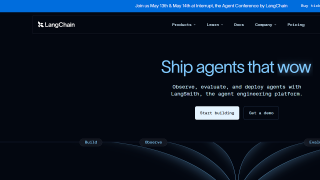
LangChain screenshot 1
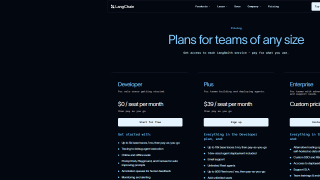
LangChain screenshot 2