Project management tools like , Notion, Basecamp, Lark, Slack, Asana and Trello.
AI chatbot tools like ChatGPT, Grok, Perplexity, Claude, Gemini and Copilot.
Marketing analytics platforms like Google Analytics, Similarweb and Semrush.
CRM systems like HubSpot, Apollo.io Pipedrive, Zoho CRM, and Salesforce.
VPNs, SSO providers, and password managers like NordVPN, Okta, and LastPass.
Email marketing and campaign tools like MailerLite, Instantly, and Mailchimp.
Website builders, hosting tools like Hostinger, Webflow, Framer, and Shopify
HR and recruiting software like ATS platforms, BambooHR, Workday, and Lever.
Automate finances with confidence like Quickbooks, Stripe, Brex, and Mercury.
Design and editing tools like Figma, Canva, Adobe Creative Cloud, CapCut.
Workflow automation tools like Zapier, Make, Clay, and Reclaim.ai.
No-code and AI-native dev tools like Cursor, Windsurf, Lovable and Bubble.

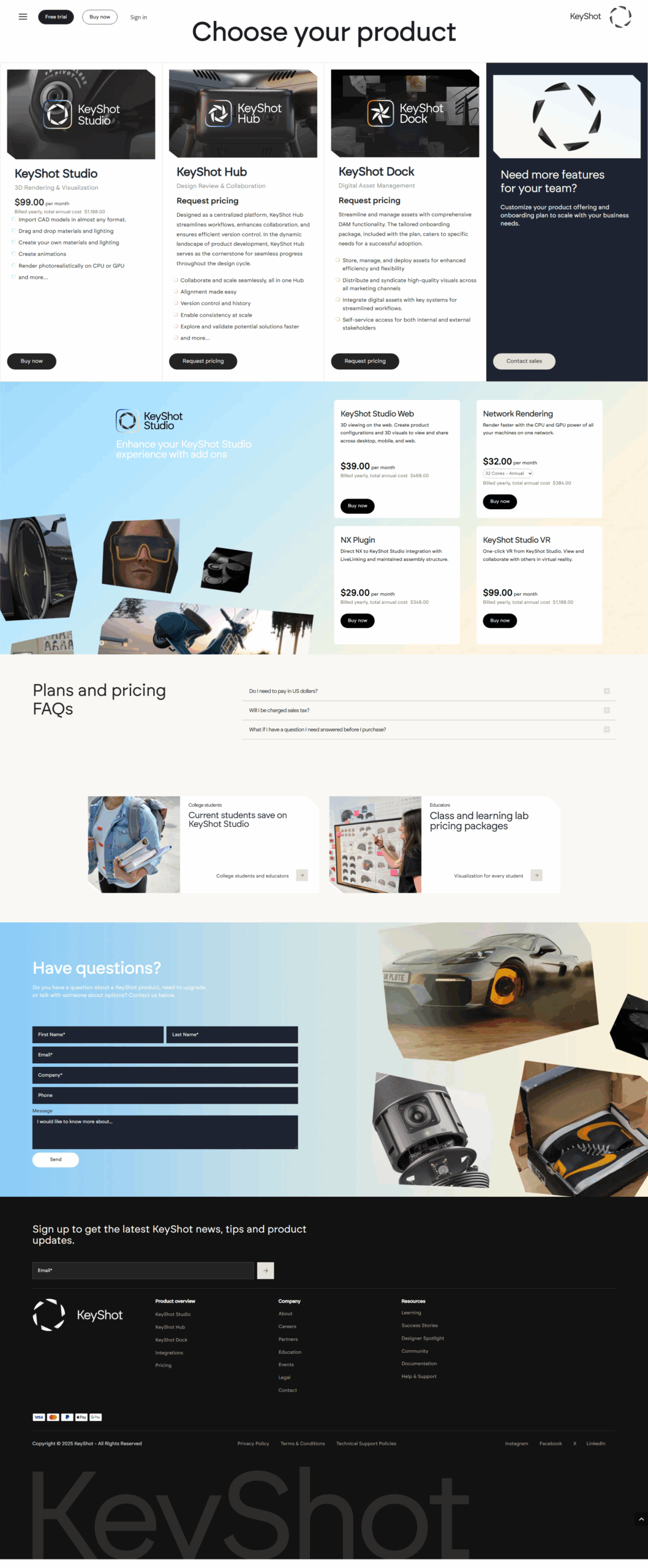
KeyShot is a leading 3D rendering software designed for designers, product developers, and creatives seeking high-quality, real-time visualization. Its standout features include real-time rendering, user-friendly interface, accurate material representation, advanced lighting, and efficient workflow integration with broad 3D file support. Offered at $1,188/year, it’s pricier than free tools like Blender but excels in ease of use and photorealistic outputs. Compared to Blender (best for modeling and animations) or V-Ray (complex lighting and film-quality output), KeyShot is ideal for quick product visualizations and marketing assets. Its minimal hardware reliance appeals to small teams, though high-speed rendering demands robust machines. Customer support is reliable, and its value justifies the cost for professionals prioritizing workflow efficiency.
Unity is a leading real-time 3D (RT3D) game engine offering intuitive tools for developers, designers, and game creators. Key features include cross-platform support, quality rendering, physics engines, asset libraries, and no-code capabilities. It excels at creating 2D/3D games, VR/AR content, and simulations. Unity’s entry-level plan is free for small-scale users, while advanced plans like Enterprise cost $200/month per seat. Compared to alternatives like Unreal Engine (better graphics) and Blender (free but less suited for games), Unity offers flexibility but has a steeper learning curve for beginners. Designers may find Unreal’s graphical edge appealing, while developers value Unity’s scripting flexibility. Customer support is rated decent, though licensing controversies raise concerns. Unity remains cost-effective and beginner-friendly for small teams or solo developers.