Sign in to review
Join our community of software reviewers on Subscribed.fyi

Continue With Google
Continue With LinkedIn
Continue Review with Email
Continue with Email
Enter your email to continue.
Continue
Enter your password
Enter your password to finish setting up your account.
Continue
Activate your email
Enter activation code we sent to your email.
Submit
Reset your password
Enter activation code we sent to your email.
Submit
Set your new password
Enter a new password for your account.
Submit
Categories
For Business
Log in
Provide My Insights
Add Product
Suggested products People also compare with
Add to Comparison
Suggested products People also compare with

Compare Pinecone and Supabase

We are comparing Pinecone and Supabase to evaluate which one is the best product.

Suggested products People also compare with
Review Pricing Alternatives Experience

Review

76%
27/36 Metric achieved
78%
28/36 Metric achieved

Subscribed Metric

Customer Support 4/6
Security 5/6
Ease of Use 4/6
Value of Money 4/6
Integration 5/6
Popularity 5/6

Subscribed Metric

Customer Support 4/6
Security 5/6
Ease of Use 4/6
Value of Money 5/6
Integration 5/6
Popularity 5/6

Pros & Cons

Fully managed serverless architecture removes the need to handle infrastructure
Delivers high-performance vector search with sub-second query responses at scale
Supports hybrid search combining vector similarity with metadata filtering
Easily integrates with modern AI stacks and embedding models
Built specifically for production AI use cases like RAG and recommendation systems
Pricing can scale quickly with increased storage, queries, and embedding usage
Closed-source platform limits customization and control
Requires understanding of embeddings and vector search concepts
Additional costs for inference and embedding generation can increase total spend

Pros & Cons

Built on PostgreSQL, offering full SQL support and strong relational data capabilities
Provides an all-in-one backend including database, auth, storage, and real-time APIs
Open-source with optional self-hosting to avoid vendor lock-in
Generous free tier with 50,000 MAUs and unlimited API requests
Automatically generates REST and GraphQL APIs from your database schema
Compute and edge function usage can increase costs beyond base plans
Requires backend knowledge (SQL, schemas) for effective use
Limited built-in tooling compared to more mature ecosystems like Firebase
Scaling complex workloads may require manual optimization and tuning

Other Platform Review

Data Unavailable This information for the product is not yet available. Please check back later or explore directly on product website.

Other Platform Review

Data Unavailable This information for the product is not yet available. Please check back later or explore directly on product website.

Conclusion

Pinecone’s main strength is its simplicity and performance. By offering a fully managed, serverless vector database, it removes the operational burden of scaling and maintaining infrastructure. This makes it particularly appealing for teams building production AI applications quickly.

However, this convenience comes with trade-offs. Pricing can become significant at scale due to usage-based billing across storage, queries, and embedding operations. Additionally, being a closed-source platform limits customization compared to open-source alternatives.

Overall, Pinecone is best suited for teams prioritizing speed, reliability, and ease of deployment over full control and cost predictability.

Conclusion

Supabase’s biggest strength is its combination of simplicity and flexibility. By building on PostgreSQL, it gives developers powerful data modeling capabilities while still offering the convenience of a managed backend. Its open-source nature and self-hosting option also reduce vendor lock-in, making it attractive for long-term projects.

However, the platform requires more technical understanding compared to plug-and-play alternatives. Developers need familiarity with SQL and backend concepts to fully leverage its capabilities. Additionally, costs can increase with compute usage, especially when scaling edge functions or high-traffic applications.

Overall, Supabase is best suited for developers who want a modern backend with strong database control, rather than a fully abstracted no-code solution.

Pricing

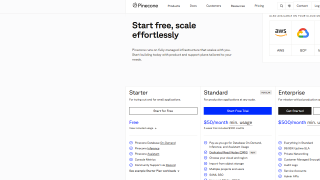
Pinecone Pricing

Pricing Range $0–Custom See Pinecone Pricing

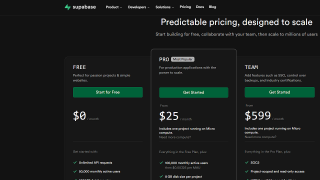
Supabase Pricing

Pricing Range $0–$599/Month See Supabase Pricing

Alternatives

Pinecone Alternatives

Milvus logo

Milvus

82%
Supabase logo

Supabase

78%
See All Pinecone Alternatives

Supabase Alternatives

Firebase logo

Firebase

85%
Render logo

Render

78%
See All Supabase Alternatives

Experience

Pinecone Screenshots

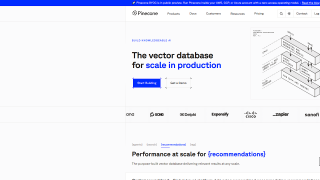
Pinecone screenshot 1
Pinecone screenshot 2

Supabase Screenshots

Supabase screenshot 1
Supabase screenshot 2