Sign in to review
Join our community of software reviewers on Subscribed.fyi

Continue With Google
Continue With LinkedIn
Continue Review with Email
Continue with Email
Enter your email to continue.
Continue
Enter your password
Enter your password to finish setting up your account.
Continue
Activate your email
Enter activation code we sent to your email.
Submit
Reset your password
Enter activation code we sent to your email.
Submit
Set your new password
Enter a new password for your account.
Submit
Categories
For Business
Log in
Provide My Insights
Add Product
Suggested products People also compare with
Add to Comparison
Suggested products People also compare with

Compare Phidata and LangChain

We are comparing Phidata and LangChain to evaluate which one is the best product.

Suggested products People also compare with
Review Pricing Alternatives Experience

Review

60%
22/36 Metric achieved
71%
25/36 Metric achieved

Subscribed Metric

Customer Support 3/6
Security 4/6
Ease of Use 3/6
Value of Money 5/6
Integration 4/6
Popularity 3/6

Subscribed Metric

Customer Support 3/6
Security 4/6
Ease of Use 3/6
Value of Money 5/6
Integration 5/6
Popularity 5/6

Pros & Cons

Open-source framework with strong flexibility for building custom AI agents
Supports multi-modal agents with memory, tools, and reasoning capabilities
Enables multi-agent systems that can collaborate on complex tasks
Model-agnostic design works with OpenAI, Groq, and other LLM providers
Includes built-in monitoring, evaluation, and debugging tools
Requires solid Python and AI engineering knowledge to use effectively
Not a plug-and-play platform, requiring setup and infrastructure decisions
Ecosystem and community are smaller compared to LangChain or similar tools
Production deployment still needs external infrastructure and configuration

Pros & Cons

Open-source framework with strong flexibility for building custom AI workflows
Supports integration with multiple LLM providers like OpenAI, Anthropic, and Hugging Face
Enables complex AI pipelines such as RAG, agents, and multi-step reasoning
Large ecosystem with extensive integrations for tools, APIs, and data sources
LangSmith platform provides observability, evaluation, and debugging tools
Steep learning curve due to abstraction layers and modular architecture
Requires engineering effort to manage scaling and production reliability
Costs can increase due to underlying model API usage and agent loops
Documentation and structure can feel fragmented for beginners

Other Platform Review

Data Unavailable This information for the product is not yet available. Please check back later or explore directly on product website.

Other Platform Review

Data Unavailable This information for the product is not yet available. Please check back later or explore directly on product website.

Conclusion

Phidata stands out as a clean, developer-first framework for building agentic AI systems. Its biggest strength is its modular design, allowing developers to combine models, tools, and memory into flexible, production-ready agents. The ability to orchestrate multiple agents and workflows gives it strong potential for complex automation use cases.

However, it is not beginner-friendly. Compared to visual tools or managed platforms, Phidata requires more engineering effort and infrastructure setup. Its ecosystem is also smaller than competitors like LangChain, which may limit available integrations and community support. Overall, Phidata is best suited for developers who want deep control over agent behavior rather than ease of use.

Conclusion

LangChain’s biggest strength is its flexibility. It allows developers to build highly customized AI applications that go beyond simple prompts, supporting complex workflows, agents, and integrations. Its ecosystem, particularly LangSmith, adds strong capabilities for debugging and improving AI systems in production.

However, this flexibility comes at the cost of complexity. Developers need a solid understanding of LLM behavior, prompt engineering, and system design to use LangChain effectively. Additionally, costs are not tied to LangChain itself but to the underlying model providers and infrastructure, which can scale unpredictably.

Overall, LangChain is best suited for advanced use cases where control, extensibility, and orchestration matter more than simplicity.

Pricing

Phidata Pricing

Pricing Range Free See Phidata Pricing

LangChain Pricing

Pricing Range Free See LangChain Pricing

Alternatives

Phidata Alternatives

LangChain logo

LangChain

71%
CrewAI logo

CrewAI

67%
AutoGen logo

AutoGen

67%
LangGraph logo

LangGraph

67%
See All Phidata Alternatives

LangChain Alternatives

Zapier logo

Zapier

85%
See All LangChain Alternatives

Experience

Phidata Screenshots

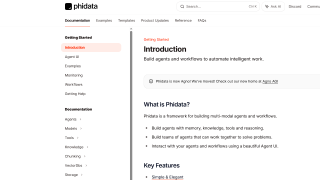
Phidata screenshot 1
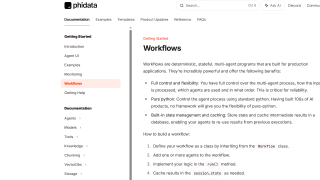
Phidata screenshot 2

LangChain Screenshots

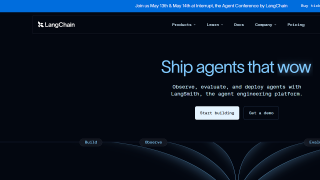
LangChain screenshot 1
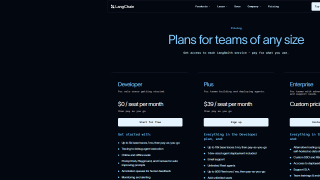
LangChain screenshot 2