Phidata Reviews 2026: Details, Pricing, & Features | Subscribed.fyi
Sign in to review
Join our community of software reviewers on Subscribed.fyi

Continue With Google
Continue With LinkedIn
Continue Review with Email
Continue with Email
Enter your email to continue.
Continue
Enter your password
Enter your password to finish setting up your account.
Continue
Activate your email
Enter activation code we sent to your email.
Submit
Reset your password
Enter activation code we sent to your email.
Submit
Set your new password
Enter a new password for your account.
Submit
Categories
For Business
Log in
Provide My Insights

Phidata Reviews, Pricing, Features & Alternatives (2026)

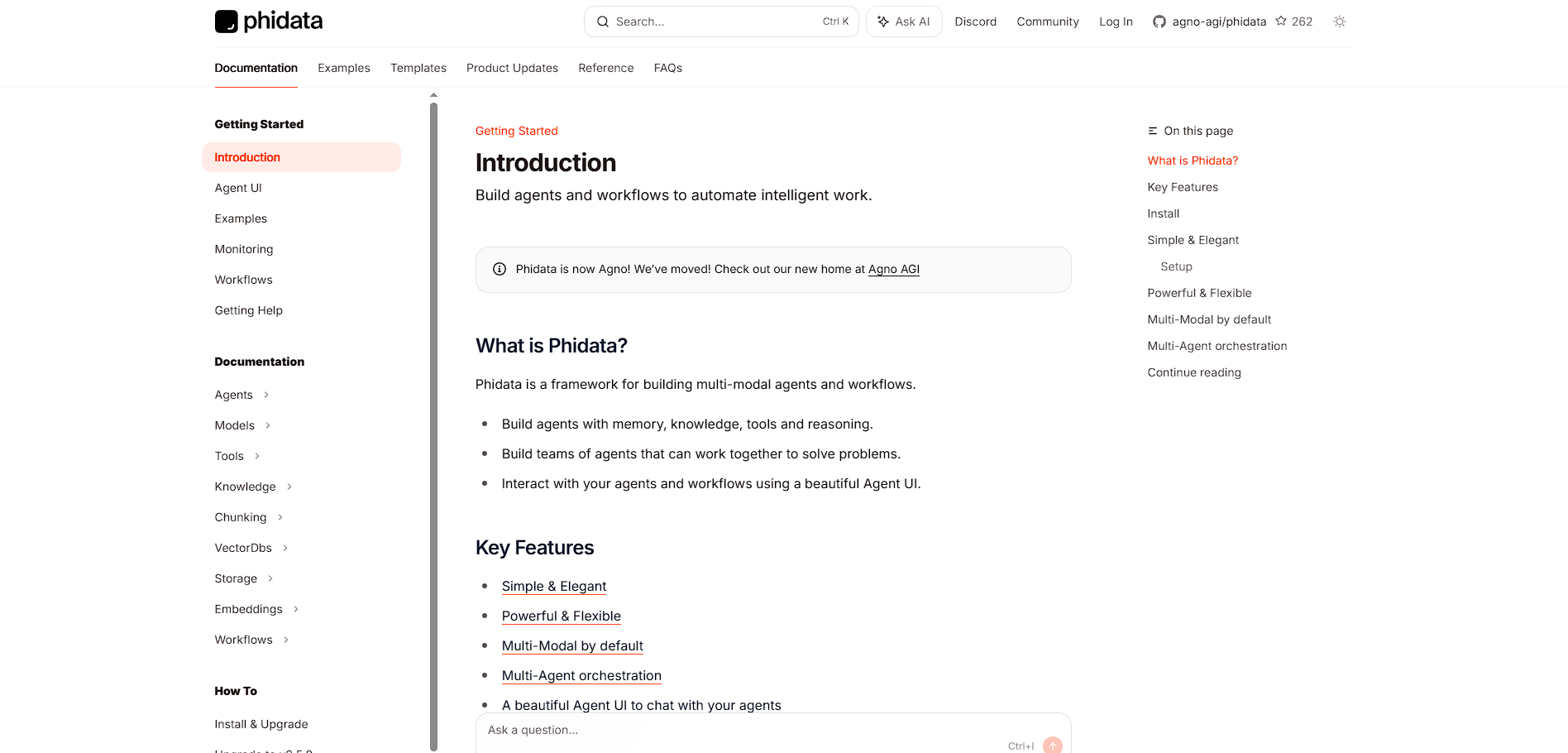
Phidata is an open-source framework for building, deploying, and managing AI agents and multi-agent workflows with memory, tools, and reasoning capabilities.

Phidata Overview

What is Phidata?

N/A
0
Reviews
60%
Subscribed Score

Available for Claim - This listing is available to be claimed
Claim Profile For Free

Unclaimed

Manage profile with subsig, and unlock 23+ social and review monitoring. Get partnership options with

Claim Profile For Free

Why teams choose Phidata

Key Features

Data-Driven Insights
Make better decisions with analytics.
Trusted by Thousands
Proven by professionals worldwide.
Save Time
Save Time
Focus on impact, not repetitive tasks.

Who is Phidata for?

Phidata is an open-source AI agent framework designed to help developers build intelligent, autonomous systems powered by large language models. It provides a structured way to create agents that can reason, use tools, access knowledge, and maintain memory, turning LLMs into functional, goal-oriented systems rather than simple chat interfaces.

The framework is built around the concept of “agentic workflows,” where multiple agents can collaborate, execute tasks, and make decisions dynamically. Developers can create everything from simple assistants to complex multi-agent pipelines that handle tasks like research, automation, and data analysis.

Phidata also includes capabilities for deployment and scaling. It supports running agents locally or in the cloud, managing memory and sessions via databases, and monitoring performance over time. Its “application-as-code” approach allows developers to define entire AI systems as Python objects, making it easier to move from development to production.

Key Features and Benefits

  • AI Agent Framework: Build autonomous agents that perform tasks using LLMs. 
  • Memory & Knowledge Integration: Agents retain context and access external data sources. 
  • Tool Use (Function Calling): Agents can execute actions like web search, APIs, or database queries. 
  • Multi-Agent Collaboration: Combine multiple agents into coordinated systems. 
  • Model-Agnostic Support: Works with various LLM providers and local models. 
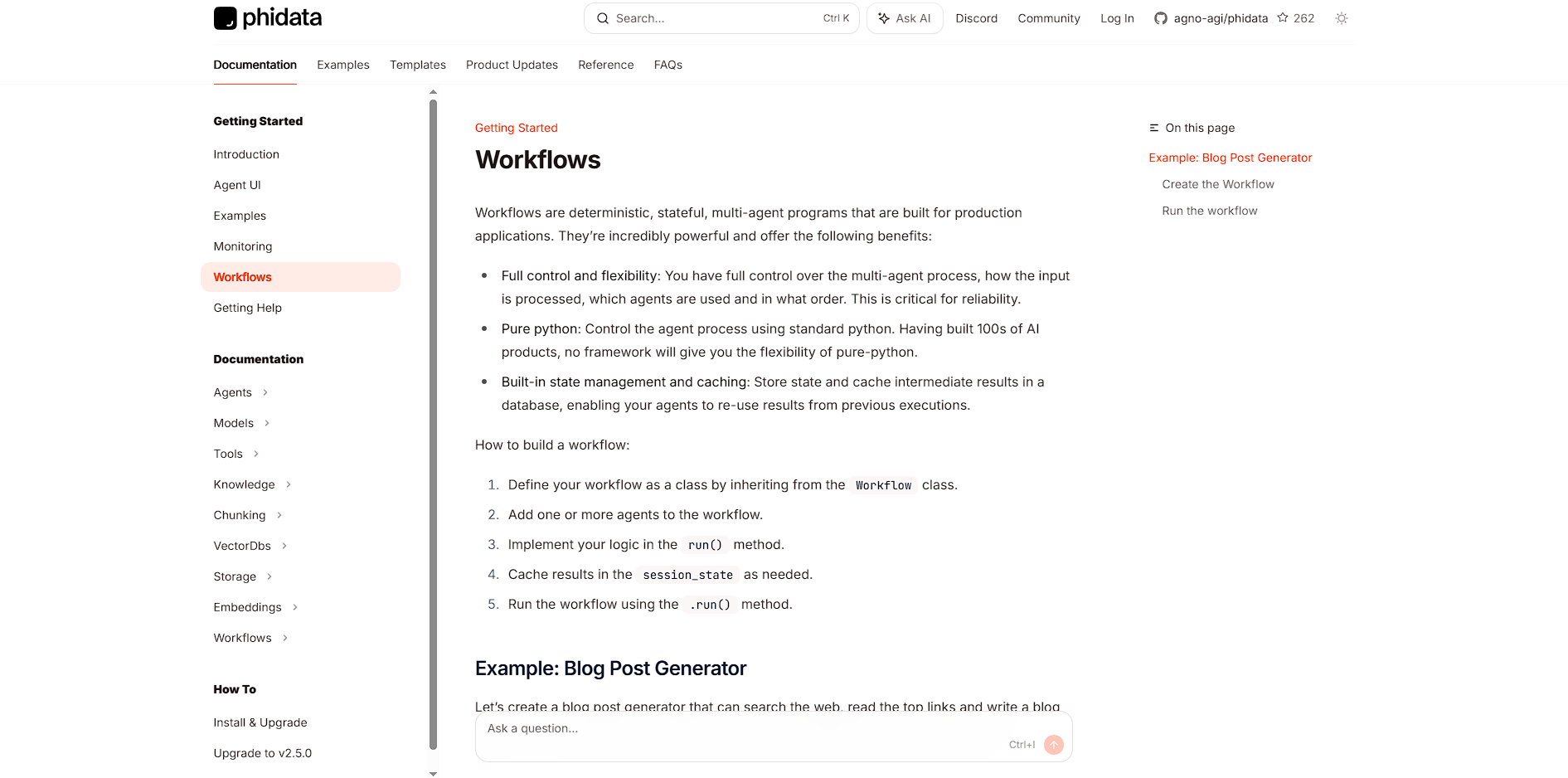
  • Agentic Workflows: Build stateful pipelines with control over execution logic. 
  • Monitoring & Evaluation: Track performance, tokens, and outputs for optimization. 

Who Can Benefit from Phidata

  • AI Engineers: Build advanced agent systems with full control and customization.
  • Developers: Turn LLMs into functional tools with memory and external integrations.
  • Startups: Create AI-powered automation and assistants quickly.
  • Research Teams: Experiment with multi-agent systems and reasoning workflows.
  • Enterprises: Automate internal processes like reporting, analysis, and support.

Looking for alternative solutions?
Alternatives include LangChain, LangGraph, CrewAI, and AutoGen. These tools offer similar agent-building capabilities, often with larger ecosystems or simpler abstractions depending on your needs.


Phidata Summary

Phidata is an open-source AI agent framework designed to help developers build intelligent, autonomous systems powered by large language models. It provides a structured way to create agents that can reason, use tools, access knowledge, and maintain memory, turning LLMs into functional, goal-oriented systems rather than simple chat interfaces.

The framework is built around the concept of “agentic workflows,” where multiple agents can collaborate, execute tasks, and make decisions dynamically. Developers can create everything from simple assistants to complex multi-agent pipelines that handle tasks like research, automation, and data analysis.

Phidata also includes capabilities for deployment and scaling. It supports running agents locally or in the cloud, managing memory and sessions via databases, and monitoring performance over time. Its “application-as-code” approach allows developers to define entire AI systems as Python objects, making it easier to move from development to production.

Key Features and Benefits

  • AI Agent Framework: Build autonomous agents that perform tasks using LLMs. 
  • Memory & Knowledge Integration: Agents retain context and access external data sources. 
  • Tool Use (Function Calling): Agents can execute actions like web search, APIs, or database queries. 
  • Multi-Agent Collaboration: Combine multiple agents into coordinated systems. 
  • Model-Agnostic Support: Works with various LLM providers and local models. 
  • Agentic Workflows: Build stateful pipelines with control over execution logic. 
  • Monitoring & Evaluation: Track performance, tokens, and outputs for optimization. 

Who Can Benefit from Phidata

  • AI Engineers: Build advanced agent systems with full control and customization.
  • Developers: Turn LLMs into functional tools with memory and external integrations.
  • Startups: Create AI-powered automation and assistants quickly.
  • Research Teams: Experiment with multi-agent systems and reasoning workflows.
  • Enterprises: Automate internal processes like reporting, analysis, and support.

Looking for alternative solutions?
Alternatives include LangChain, LangGraph, CrewAI, and AutoGen. These tools offer similar agent-building capabilities, often with larger ecosystems or simpler abstractions depending on your needs.

Phidata reviews and insights

Learn what people say about Phidata

N/A
0 Reviews
60%
Subscribed Score

Lear more here about the Subscribed score on how it is composed. Learn more Click here

Overall rating

5
4
3
2
1
CX 3/6

How good is the customer support based on subscribed’s assessment

CX Icon
Security 4/6

How secure is the product based on Subscribed’s assessment?

Security Icon
Ease of Use 3/6

How easy is the product to use, based on Subscribed’s assessment?

EOU Icon
Value 5/6

What is the value for money based on Subscribed’s assessment?

coin Icon
Integration 4/6

How many integrations does the product offer?

gear Icon
Popularity 3/6

How popular is the product?

star

No Reviews Yet!

Be the first to share your experience and help others in the community.

Phidata User Reviews

0 User Reviews

Reviews from G2, Capterra, Trustpilot
info Icon

These ratings come directly from third-party platforms like G2, Capterra, and Trustpilot. They reflect real user feedback collected independently on those sites.

Phidata pricing

Pricing model

Pricing Range
info Icon

This only an estimated pricing range, visit Phidata pricing page to access all the information by clicking “Visit Now”.

Free
Visit Now
✨ Ask AI about pricing
60% Subscribed Score
info Icon

The Subscribed Score is an independent rating that combines user reviews, features, and value-for-money from multiple trusted sources. It’s designed as a quick benchmark, not a guarantee of individual experience.

Overview

Phidata is an open-source AI agent framework designed to help developers build intelligent, autonomous systems powered by large language models. It provides a structured way to create agents that can reason, use tools, access knowledge, and maintain memory, turning LLMs into functional, goal-oriented systems rather than simple chat interfaces.

The framework is built around the concept of “agentic workflows,” where multiple agents can collaborate, execute tasks, and make decisions dynamically. Developers can create everything from simple assistants to complex multi-agent pipelines that handle tasks like research, automation, and data analysis.

Phidata also includes capabilities for deployment and scaling. It supports running agents locally or in the cloud, managing memory and sessions via databases, and monitoring performance over time. Its “application-as-code” approach allows developers to define entire AI systems as Python objects, making it easier to move from development to production.

Key Features and Benefits

  • AI Agent Framework: Build autonomous agents that perform tasks using LLMs. 
  • Memory & Knowledge Integration: Agents retain context and access external data sources. 
  • Tool Use (Function Calling): Agents can execute actions like web search, APIs, or database queries. 
  • Multi-Agent Collaboration: Combine multiple agents into coordinated systems. 
  • Model-Agnostic Support: Works with various LLM providers and local models. 
  • Agentic Workflows: Build stateful pipelines with control over execution logic. 
  • Monitoring & Evaluation: Track performance, tokens, and outputs for optimization. 

Who Can Benefit from Phidata

  • AI Engineers: Build advanced agent systems with full control and customization.
  • Developers: Turn LLMs into functional tools with memory and external integrations.
  • Startups: Create AI-powered automation and assistants quickly.
  • Research Teams: Experiment with multi-agent systems and reasoning workflows.
  • Enterprises: Automate internal processes like reporting, analysis, and support.

Looking for alternative solutions?
Alternatives include LangChain, LangGraph, CrewAI, and AutoGen. These tools offer similar agent-building capabilities, often with larger ecosystems or simpler abstractions depending on your needs.

Where Phidata performs best

What users like
  • Open-source framework with strong flexibility for building custom AI agents
  • Supports multi-modal agents with memory, tools, and reasoning capabilities
  • Enables multi-agent systems that can collaborate on complex tasks
  • Model-agnostic design works with OpenAI, Groq, and other LLM providers
  • Includes built-in monitoring, evaluation, and debugging tools

Where Phidata falls short

What users dislike
  • Requires solid Python and AI engineering knowledge to use effectively
  • Not a plug-and-play platform, requiring setup and infrastructure decisions
  • Ecosystem and community are smaller compared to LangChain or similar tools
  • Production deployment still needs external infrastructure and configuration
Subscribed Score Metrics
22/36 Metric achieved
MetricsScore
Customer Support3/6
Security4/6
Ease of Use3/6
Value of Money5/6
Integration4/6
Popularity3/6
Radar Chart Table View
Ease of Use
Measures how simple and intuitive the product is to use, including setup, navigation, and overall user experience
3/6 Metric Checks
Security
Compares the product`s features, quality, and pricing to determine its overall cost-effectiveness.
4/6 Metric Checks
Value of Money
Assesses the product`s ability to protect data, prevent breaches, and comply with industry standards.
5/6 Metric Checks
Customer Support
Reflects the responsiveness, helpfulness, and quality of assistance provided by the product`s support team.
3/6 Metric Checks
Integrations
Evaluates how well the product connects with other tools and platforms, enabling seamless workflows.
4/6 Metric Checks
Phidata Pricing Range
Free

Phidata in action
info Icon

A curated gallery of real screenshots and use cases from the product, so you can see how it works before trying it.

Phidata Full Screen Icon
https://www.youtube.com/watch?v=sVBFPNW_GGc&list=PLUBL8w2KtS3OL-RgUDsF6xLBswfDGvVXJ&index=2
Full Screen Icon
Phidata
Phidata
Video thumbnail
Phidata
Phidata

Alternatives to Phidata
info Icon

A list of platforms similar to Phidata, helping you evaluate which tool best matches your needs.

How to cancel Phidata

Need to cancel Phidata? Here is how
info Icon

Thinking about how to cancel Phidata this is how you do it!

  • Stop running Phidata agents and workflows
  • Shut down local or cloud deployments
  • Revoke API keys from LLM providers
  • Remove connected databases or integrations
  • Confirm no active infrastructure usage

How to Cancel the Phidata

  • Stop running Phidata agents and workflows
  • Shut down local or cloud deployments
  • Revoke API keys from LLM providers
  • Remove connected databases or integrations
  • Confirm no active infrastructure usage

FAQs about Phidata

Every else you need to know about Phidata
info Icon

A collection of FAQs, guides, alternatives, and comparisons to help you quickly understand if Phidata is right for you.

Manage your Phidata profile

Create profile

Want to list your product on Subscribed.fyi? Create a profile to reach more buyers.

Pricing Range
info Icon

This only an estimated pricing range, visit Phidata pricing page to access all the information by clicking “Visit Now”.

Free
Visit Now