Sign in to review
Join our community of software reviewers on Subscribed.fyi

Continue With Google
Continue With LinkedIn
Continue Review with Email
Continue with Email
Enter your email to continue.
Continue
Enter your password
Enter your password to finish setting up your account.
Continue
Activate your email
Enter activation code we sent to your email.
Submit
Reset your password
Enter activation code we sent to your email.
Submit
Set your new password
Enter a new password for your account.
Submit
Categories
For Business
Log in
Provide My Insights
Add Product
Suggested products People also compare with
Add to Comparison
Suggested products People also compare with

Compare Tabnine and Continue.dev

We are comparing Tabnine and Continue.dev to evaluate which one is the best product.

Suggested products People also compare with
Review Pricing Alternatives Experience

Review

69%
25/36 Metric achieved
67%
24/36 Metric achieved

Subscribed Metric

Customer Support 4/6
Security 5/6
Ease of Use 4/6
Value of Money 4/6
Integration 4/6
Popularity 4/6

Subscribed Metric

Customer Support 3/6
Security 5/6
Ease of Use 3/6
Value of Money 5/6
Integration 4/6
Popularity 4/6

Pros & Cons

Strong focus on privacy with options for on-premise and air-gapped deployments
Supports multiple AI models and allows switching between providers
Integrates seamlessly with major IDEs like VS Code and JetBrains
Provides context-aware code completion and AI chat across entire codebases
Includes governance, auditability, and compliance controls for enterprise teams
Less advanced generative capabilities compared to newer AI coding agents
Setup and configuration can be complex for enterprise deployments
Pricing is relatively high for team and enterprise tiers
Free tier has limited capabilities compared to competitors

Pros & Cons

Fully open-source with no vendor lock-in, allowing complete customization
Supports multiple LLM providers including OpenAI, Claude, and local models
Deep IDE integration for VS Code and JetBrains with real-time coding assistance
Includes agent workflows for automating tasks like refactoring and pull request checks
Can run locally for enhanced privacy and control over data
Steeper learning curve compared to plug-and-play tools like Copilot
Requires manual setup and configuration for optimal performance
UI and user experience are less polished than commercial alternatives
Community-driven support can be inconsistent for advanced issues

Other Platform Review

Data Unavailable This information for the product is not yet available. Please check back later or explore directly on product website.

Other Platform Review

Data Unavailable This information for the product is not yet available. Please check back later or explore directly on product website.

Conclusion

Tabnine’s biggest strength is its privacy-first architecture and deployment flexibility. The ability to run models locally or in secure environments makes it a top choice for enterprises handling sensitive codebases. Its governance features and auditability also give organizations more control compared to typical AI coding tools.

However, compared to newer AI coding agents, Tabnine can feel less advanced in terms of creativity and autonomous capabilities. Its pricing and complexity may also be barriers for smaller teams. It performs best in enterprise environments where security, compliance, and control outweigh the need for cutting-edge generative features.

Conclusion

Continue.dev stands out for its flexibility, open-source nature, and deep integration into the development lifecycle. Its ability to connect to multiple models and run locally makes it particularly attractive for teams concerned about privacy and vendor dependency. The addition of agent-based workflows and CI/CD integration elevates it beyond simple coding assistants.

However, this flexibility comes with complexity. The setup process and learning curve can be a barrier for beginners, and the overall user experience is less polished than commercial alternatives. It is best suited for developers and teams who value control, customization, and long-term scalability over simplicity.

Pricing

Tabnine Pricing

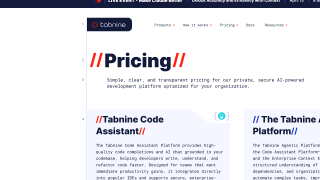
Pricing Range $12–$39/Month See Tabnine Pricing

Continue.dev Pricing

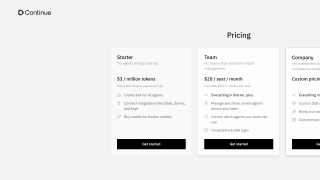
Pricing Range Free See Continue.dev Pricing

Alternatives

Tabnine Alternatives

GitHub logo

GitHub

85%
Continue.dev logo

Continue.dev

67%
See All Tabnine Alternatives

Continue.dev Alternatives

GitHub logo

GitHub

85%
Windsurf logo

Windsurf

69%
See All Continue.dev Alternatives

Experience

Tabnine Screenshots

Tabnine screenshot 1
Tabnine screenshot 2

Continue.dev Screenshots

Continue.dev screenshot 1
Continue.dev screenshot 2